The 2-2-3 Custody Schedule Explained: Examples and Who It Suits

If you're looking for a 50/50 arrangement that doesn't keep your children away from either parent for a whole week, the 2-2-3 custody schedule is probably already on your shortlist. It's one of the most popular rotations for younger children — and one of the most misunderstood, because the pattern flips every week. This article walks through exactly how it works, what a typical fortnight looks like, who it suits (and who it doesn't), and how to run it day to day without anyone losing track.
What is the 2-2-3 custody schedule?
The 2-2-3 schedule is a 50/50 custody rotation that divides each week into three blocks: two days with one parent, two days with the other parent, then three days — usually the weekend — back with the first. The following week, the whole pattern flips, so each parent alternates weekends with the children.
Concretely, in week one, Parent A has Monday and Tuesday, Parent B has Wednesday and Thursday, and Parent A takes Friday through Sunday. In week two, Parent B has Monday and Tuesday, Parent A has Wednesday and Thursday, and Parent B has the weekend. Then the cycle starts over.
Over any two-week cycle, each parent has exactly seven overnights, which makes 2-2-3 a genuine equal-time arrangement. What sets it apart from other 50/50 rotations is the rhythm: the children never spend more than three consecutive days away from either parent. That short gap is precisely why this schedule is so often suggested for toddlers and preschoolers.
A two-week example: Mia, age 4
Abstract patterns are hard to picture, so here's what the rotation looks like for Mia, whose parents, Sarah and Tom, live fifteen minutes apart.
Week 1:
- Monday–Tuesday: Mia is with Sarah. Sarah drops her at preschool Wednesday morning.
- Wednesday–Thursday: Tom picks Mia up from preschool Wednesday afternoon. She stays with him two nights.
- Friday–Sunday: Sarah picks Mia up Friday afternoon and keeps her through the weekend, dropping her at preschool Monday morning.
Week 2:
- Monday–Tuesday: Tom picks Mia up Monday and has her for two nights.
- Wednesday–Thursday: Back to Sarah for two nights.
- Friday–Sunday: Tom has the weekend, and the cycle resets on Monday.
Notice one detail that makes the whole thing smoother: almost every handover happens at preschool. Sarah drops off in the morning; Tom picks up in the afternoon. The parents rarely need to meet face to face, the transitions feel routine to Mia, and nobody stands on a doorstep checking their watch. Using school or daycare as the exchange point is one of the most effective ways to reduce friction in any custody schedule, and 2-2-3 — with its frequent transitions — benefits from it more than most.
Who the 2-2-3 schedule suits best
No schedule is objectively the best; there is only the best fit for your child's age, your geography and your working lives. That said, 2-2-3 has a fairly clear profile.
It tends to work well when…
- Your children are young — roughly ages 2 to 6. Young children experience time differently: a week without a parent can feel very long. Short, frequent blocks help them keep a strong, continuous bond with both parents.
- You live close to each other — ideally within the same school catchment, or a short drive apart. With six or more transitions per fortnight, distance turns this schedule into a logistics problem fast.
- Both parents can handle weekday routines. Each of you will do school runs, homework-adjacent evenings, bath time and bedtime every single week. That's a feature, not a bug — but it requires compatible work schedules.
- Communication between you is workable. Not warm, necessarily — just functional. Frequent handovers mean frequent small updates: the cough that started last night, the permission slip due Friday.
It's usually a poor fit when…
- Parents live far apart. Long commutes multiplied by frequent exchanges exhaust everyone, starting with the child.
- Children are older. Many school-age kids, and most teenagers, find the constant switching disruptive — sports, friends and homework all benefit from longer, more stable blocks.
- Conflict is high. If every exchange is a potential flashpoint, a schedule with fewer transitions (or a parallel-parenting setup) usually protects the children better.
- One parent's job involves irregular hours, frequent travel or shift work that clashes with a fixed weekly rhythm.
Pros and cons of the 2-2-3 rotation
The advantages
- Short separations. Neither parent — and more importantly, neither child — goes more than three days without seeing the other. For young children, this is the schedule's core strength.
- Alternating weekends. Both parents get relaxed, unhurried weekend time every other week, rather than one parent becoming the "fun weekend parent" by default.
- Both parents stay in the real routine. School mornings, packed lunches, meltdowns at bedtime: each parent stays fully fluent in the child's everyday life.
- True 50/50 time, which many separated parents value both emotionally and practically.
The drawbacks
- Lots of transitions. Six exchanges per fortnight is a lot of bags, coats, chargers and favorite stuffed animals moving between homes.
- The flipping pattern is confusing. Because weekdays alternate week to week, neither parent has a fixed "Monday." Without a clear shared calendar, mistakes happen.
- Frequent coordination. More handovers means more touchpoints between co-parents. If your communication is fragile, this schedule tests it constantly.
- Harder to plan around. Recurring activities and work commitments are trickier when your child-free evenings change from one week to the next.
2-2-3 vs. other 50/50 schedules
The 2-2-3 sits at one end of a spectrum that runs from "frequent switches, short blocks" to "rare switches, long blocks." Where your family lands on that spectrum mostly depends on your child's age and tolerance for transitions.
- 2-2-5-5: each parent has a fixed pair of weekdays (say, Monday–Tuesday for one, Wednesday–Thursday for the other), and weekends alternate as five-day blocks. Fewer transitions than 2-2-3, with predictable weekdays — a common next step as children reach school age.
- 3-4-4-3: similar idea with slightly different block lengths; also gives each parent anchored weekdays.
- Week on/week off: the simplest rotation of all — one exchange per week — but a full seven days away from each parent, which is generally better suited to older children. Our guide to week on/week off custody covers when that trade-off makes sense.
If you're still weighing your options, our complete guide to 50/50 custody schedules compares all of these patterns side by side and walks through how to choose.
Making 2-2-3 work day to day
Families who thrive on 2-2-3 tend to do a few unglamorous things consistently.
- Put the rotation in a shared calendar — once, for the whole year. Because the pattern flips weekly, mental math fails and screenshots of text messages get stale. A single source of truth both parents can see prevents most disputes before they start. Here's how to build a shared custody calendar both parents actually follow. A co-parenting app like Hyphen can generate the full 2-2-3 rotation automatically and keep both homes looking at the same schedule.
- Use school or daycare as the default exchange point. Morning drop-off by one parent, afternoon pickup by the other. Fewer face-to-face handovers, calmer transitions.
- Duplicate the essentials. Toothbrushes, pajamas, rain boots, a spare of the beloved comfort object if you can manage it. The less that has to travel, the fewer forgotten-item emergencies.
- Agree on a swap procedure in advance. Life happens — a work trip, a birthday party, a sick grandparent. Decide now how one-off changes get requested and confirmed, so each swap isn't a fresh negotiation. We've detailed a simple system for swapping custody days without drama.
- Keep handover updates short and factual. A two-line message at each transition — sleep, health, homework, mood — keeps both parents informed without turning every exchange into a conversation.
When it's time to move on from 2-2-3
The 2-2-3 is rarely forever. Many families use it during the preschool years, then shift to a 2-2-5-5 or a week-on/week-off rhythm as the child grows. Signs it may be time to revisit the schedule include a child who starts resisting transitions, activities that no longer fit the rotation, a house move, or a change in either parent's work.
Treat the schedule as something you review — calmly, maybe once a year — rather than a fixed monument. If you and your co-parent agree on a change, updating your parenting plan can be straightforward; if you don't, a family mediator can help, and for anything binding you should consult a family law professional in your jurisdiction, since rules vary widely. What matters is that the schedule keeps serving the child it was designed for, at the age they are now — not the age they were when you signed it.
Put this into practice with Hyphen
Shared custody calendar, calmer messaging and expense tracking — everything you need to co-parent peacefully, in one app.
Download Hyphen on the App StoreFrequently asked questions
Is the 2-2-3 schedule a true 50/50 custody arrangement?
Yes. Over a two-week cycle, each parent has exactly seven overnights, so parenting time is split equally. The difference from other 50/50 schedules is the rhythm: short blocks and frequent exchanges rather than long stretches.
How many exchanges does a 2-2-3 custody schedule involve?
Three exchanges per week, or six per fortnight. Many families soften this by using school or daycare as the handover point, so most transitions happen through drop-off and pickup rather than face-to-face meetings.
Is the 2-2-3 schedule good for toddlers?
It's one of the most commonly recommended rotations for toddlers and preschoolers, because the child never spends more than three days away from either parent. That said, every child is different — watch how yours handles transitions and adjust if needed.
What's the difference between 2-2-3 and 2-2-5-5?
In 2-2-3, the weekday pattern flips every week, so neither parent has fixed days. In 2-2-5-5, each parent keeps the same two weekdays every week and weekends alternate as five-day blocks. The 2-2-5-5 has fewer transitions and is often the next step as children get older.
Does 2-2-3 work if parents live far apart?
Generally not well. With three exchanges a week, distance quickly turns the schedule into a burden, especially for the child. Families living far apart usually do better with longer blocks, such as week on/week off, or a schedule built around school holidays.
Keep reading

Complete Guide to 50/50 Custody Schedules: Week On/Week Off, 2-2-3, 2-2-5-5, 3-4-4-3
Compare 50/50 custody schedules — week on/week off, 2-2-3, 2-2-5-5, 3-4-4-3 — with real examples and a simple method to pick the right rhythm.
7 min read
How to build a shared custody calendar both parents actually follow
Build a shared custody calendar both parents actually follow: pick a rhythm, one source of truth, clear rules and a calm process for swaps and holidays.
7 min read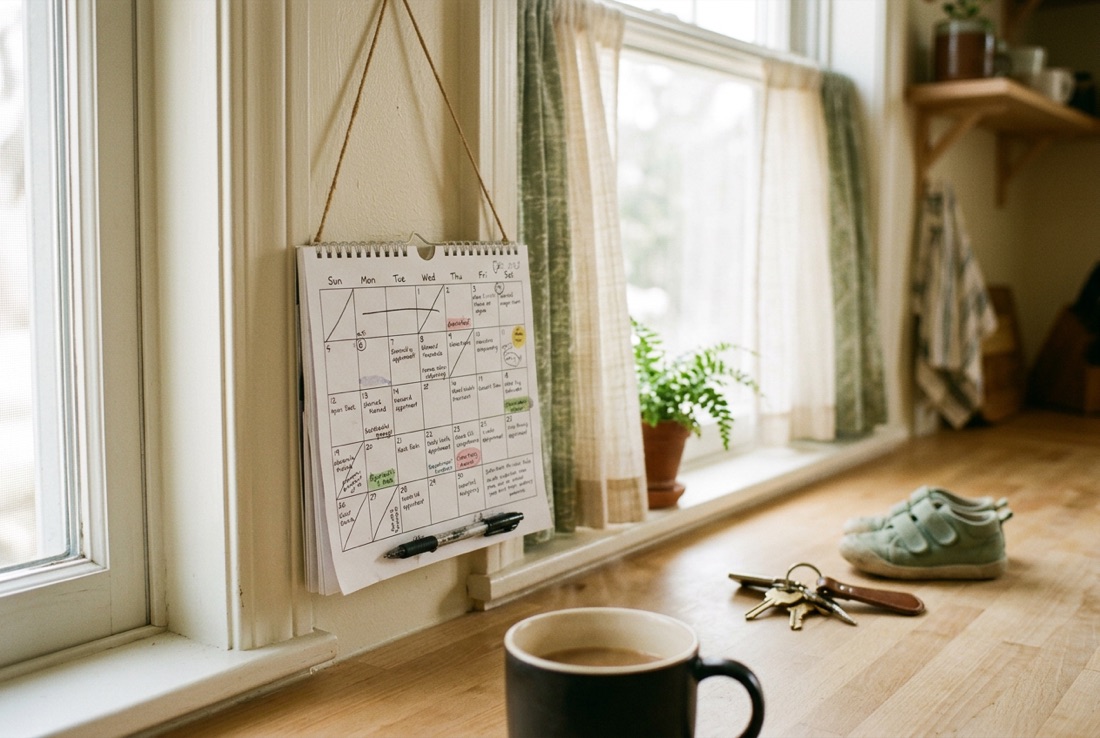
Changing a Custody Schedule: When It Makes Sense and How to Do It Smoothly
When to change a custody schedule and how to do it smoothly: signs it's time, talking to your co-parent, trial periods and making it official.
8 min read