The two-homes checklist: what to duplicate, what travels, and what to never forget
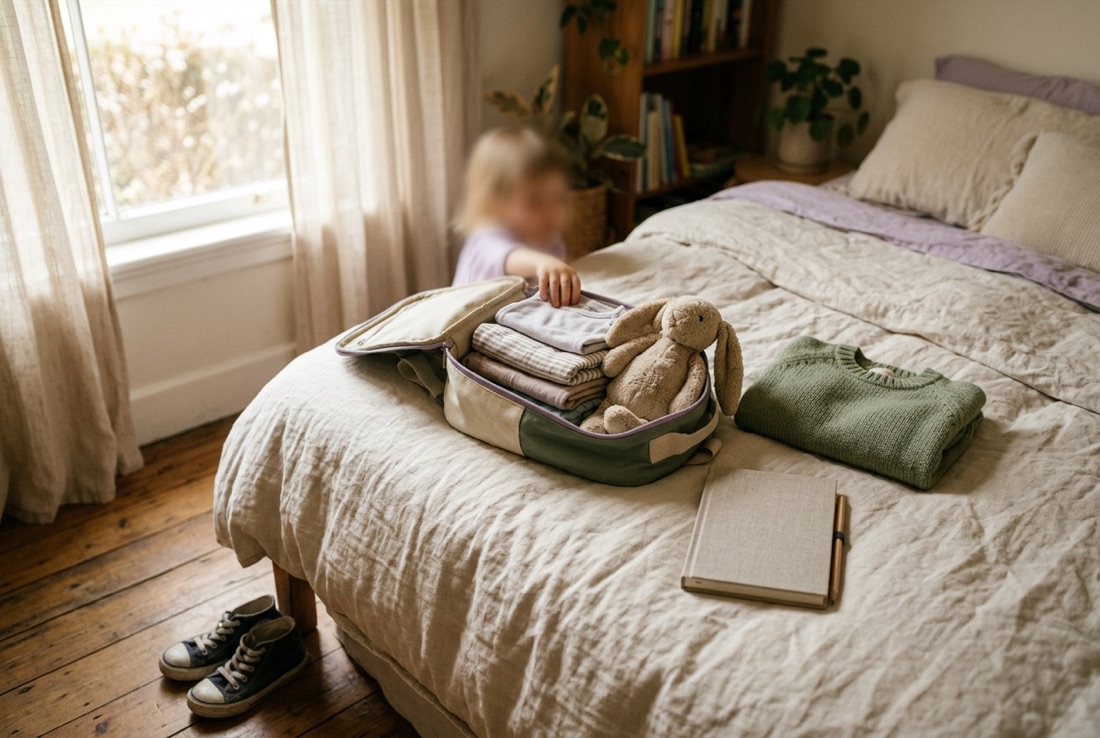
The bag by the door, half-zipped, at 8:12 on a school morning. The frantic text an hour after handover: "Did Lucas's inhaler come with him?" If you're raising kids across two homes, you know that particular low-grade dread. It rarely comes from big things. It comes from the toothbrush, the charger, the one stuffed animal that makes bedtime possible. This article gives you a working system: what to buy twice so it never travels, what genuinely needs to move between homes, and the short list you should never forget.
Why a custody packing checklist saves more than time
A good custody packing checklist isn't about being organised for its own sake. It's about protecting your child from the emotional cost of transitions. Every forgotten item is a small message: your life here is provisional, you have to carry it back and forth. Every duplicated item, by contrast, quietly says: you belong fully in both places.
There's a practical payoff too. When the system is clear, you stop needing to coordinate the small stuff by text — which means fewer of the terse exchanges that turn a Sunday evening sour. The goal is a setup where a seven-year-old could pack their own bag, and where nobody has to ask the other parent for the swim kit twice a month.
Think in three buckets: what stays put (duplicated), what travels, and what must never be forgotten. Everything below sorts into one of those three.
What to duplicate: the "never travels" list
Some things should simply exist in both homes, permanently. Duplicating them costs a little upfront but removes a whole category of daily friction. You're not buying two of everything — you're buying two of the things a child touches every single day, or that cause real distress when missing.
Worth owning twice
- Toiletries: toothbrush, toothpaste, hairbrush, shampoo, any daily skincare. These are cheap and deeply annoying to forget.
- Basic clothing: a week of underwear, socks, pyjamas, and a couple of everyday outfits at each home. This is the single biggest reducer of laundry-related tension.
- Chargers and cables: one for the tablet, one for the phone or watch, at each address. Chargers are the most forgotten item on earth.
- School and craft basics: pencils, glue, scissors, a ruler. Not the specific homework — just the tools.
- Comfort duplicates where possible: a second nightlight, a spare water bottle, a blanket. Some comfort objects can't be duplicated (more on that below), but many can.
Take Sofia, seven. Her parents agreed to stock identical toiletry baskets in each bathroom and a full drawer of basics at each home. Within a month, her Friday handovers stopped involving a suitcase at all — she walked between homes with a small backpack and nothing else. That shift, from "packing to leave" to "just going," is exactly what you're aiming for. It's a core part of helping a child feel genuinely at home in two houses rather than a permanent guest in one.
What travels: the moving list
Some things can't or shouldn't be duplicated, either because they're expensive, irreplaceable, or genuinely singular. These form your travel list — the items that ride along at every handover.
- Medication and medical devices: inhalers, prescriptions, orthodontic retainers, glasses. If it's prescribed for your child specifically, it travels (unless a doctor advises a duplicate supply).
- The current schoolwork: the reading book, the project due Thursday, the signed permission slip. School follows the child, not the calendar.
- Sports and activity kit: the football boots, the ballet shoes, the instrument. Duplicating these is usually too costly, so they travel with the activity.
- The one true comfort object: the specific bear, the specific blanket. Never try to substitute this — a lookalike rarely works and can make things worse. It travels, always, and it's worth building the whole handover routine around remembering it.
- Devices with personal data: the tablet or phone the child actually uses, with their photos, saved games, and messages to friends.
A quick rule of thumb: if forgetting it means a special trip back, a purchase, or a genuinely upset child, it belongs on the travel list and deserves a fixed spot in the bag.
The never-forget shortlist
Out of everything, a handful of items cause the most disruption when they go missing. Keep this list short and visible — on the fridge, in a shared note, wherever both parents will see it. These are the non-negotiables to check before every single handover:
- Medication (and enough of it to cover the full stay).
- The comfort object. The bear. Whatever it is.
- Glasses, retainer, hearing aids — anything the child's body relies on.
- Tomorrow's specific requirement: the costume for the school play, the boots for the match, the signed form.
- The device charger for whatever the child brought.
Five items. If those five make it, the day is saved even if a pair of socks doesn't. Everything else is recoverable; these aren't, quickly.
Building a packing routine kids can own
The best checklist is one your child eventually runs themselves. That's not just convenient — it gives them a small, real sense of agency during a transition where they otherwise feel moved around by adults. Build the routine gradually and age-appropriately.
Make it visible and repeatable
- A fixed packing spot: the same bag, in the same place, packed the evening before — not in the morning rush. Calm packing prevents forgotten items far better than any list.
- A simple visual list for younger children: pictures of the five essentials taped inside the bag lid works well for pre-readers.
- A pre-handover check the child does out loud: "Medicine, bear, glasses, tomorrow's thing, charger." Five seconds, huge payoff.
For older kids and teens, hand over the ownership fully but keep a light backstop. A quick shared list they can tick off respects their growing independence while catching the one thing they'd genuinely regret forgetting. This kind of predictable structure is closely tied to keeping routines consistent across both homes — packing is just one routine among several, and it gets easier when the whole rhythm is steady.
Keeping the system running between two adults
A checklist only works if both parents use the same one. This is where the real coordination lives — not in the items themselves, but in staying aligned without turning every handover into a negotiation.
Agree once on who owns what. Decide which home keeps the sports kit during which season, who restocks the shared medication, who holds the passport. Write it down somewhere you both can see, so nobody has to remember a verbal agreement made three months ago. A shared calendar or a co-parenting app like Hyphen can hold the packing list and the handover schedule in one place, so a missing swim kit is a glance away from being sorted rather than a round of blame.
A few principles keep the system calm:
- Report facts, not faults. "The retainer didn't come with Lucas today" is workable. "You forgot his retainer again" starts a fight. The item still needs to get back either way.
- Build in a buffer. Keep a few spare basics at each home so a single forgotten bag doesn't derail a school morning. Slack in the system absorbs the inevitable human misses.
- Review the list occasionally. Kids grow, activities change, the retainer comes out. A checklist from last year isn't the one you need now.
None of this requires a perfect relationship with your co-parent. It requires a shared, boring, reliable system — which is often easier to agree on than the bigger emotional questions, and a good place to start rebuilding cooperation.
When the checklist matters most
Certain moments raise the stakes: the start of a new custody arrangement, the first weeks after telling the children about the separation, holidays, and the beginning of a school year. In those windows, forgotten items land harder because everyone's already stretched. If you're early in the process, it's worth pairing this practical setup with the gentler work of helping kids understand the separation itself — the logistics and the emotions are two halves of the same transition.
The checklist won't make separation easy. But it removes a recurring, avoidable source of stress from your child's week — and gives them the quiet reassurance that in both homes, everything they need is already there, waiting for them.
Put this into practice with Hyphen
Shared custody calendar, calmer messaging and expense tracking — everything you need to co-parent peacefully, in one app.
Download Hyphen on the App StoreFrequently asked questions
What should I duplicate versus pack for two homes?
Duplicate the cheap daily-use items: toiletries, basic clothing, chargers, and school supplies. Pack (travel) the things that are expensive, singular, or irreplaceable: medication, the current schoolwork, sports kit, devices, and the one true comfort object. If forgetting it means a special trip or an upset child, it should travel.
What are the most important things to never forget at a custody handover?
Keep a short list of five: medication, the comfort object, anything the child's body relies on (glasses, retainer, hearing aids), tomorrow's specific requirement (costume, boots, signed form), and the device charger. If those five make the trip, the day is saved even if smaller items don't.
How do I get my child to pack their own bag between homes?
Use a fixed packing spot and pack the evening before, never in the morning rush. For younger children, tape a picture list of the five essentials inside the bag. For older kids, hand over ownership but keep a light shared checklist as a backstop so nothing important slips through.
How do I handle a forgotten item without starting a fight with my ex?
Report the fact, not the fault: "The inhaler didn't come today" rather than "you forgot it again." Keep spare basics at each home so a single miss doesn't derail a school morning, and agree in advance who restocks shared essentials so nobody has to negotiate in the moment.
Should comfort objects like a favourite stuffed animal be duplicated?
Usually not. Children can tell the difference, and a substitute often makes things worse rather than better. Treat the one true comfort object as a travel item that always moves with the child, and build your handover check around remembering it every time.
Keep reading

Birthdays, School Shows and Special Events: Showing Up as Co-Parents
Birthday shared custody plans, school shows and holidays: practical ways to show up as co-parents without tension. Keep the day about your child.
7 min read
When Your Child Becomes the Messenger Between Homes: How to Take Them Out of the Middle
"Tell your dad..." Using a child messenger after divorce quietly harms them. Here's why it happens and concrete ways to take your child out of the middle.
6 min read
When Your Child Refuses to Go to the Other Parent's Home
When your child refuses to visit a parent, it's rarely rejection. Understand the real reasons and get calm, concrete steps to respond and ease transitions.
7 min read