Helping Your Child Name and Express Feelings About the Separation, by Age
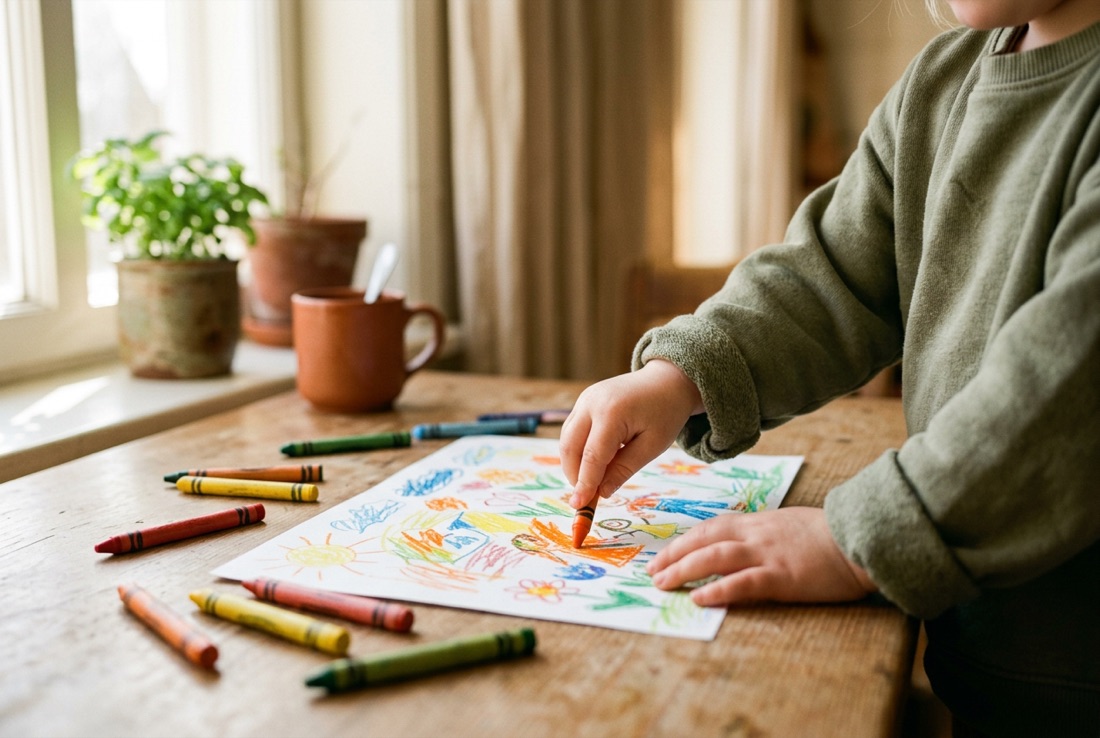
When parents separate, children rarely have the words for what they feel. They feel it in their bodies, in their sleep, in their behaviour long before they can say "I'm scared this is my fault" or "I miss the way things were." Helping your child name and express their emotions is one of the most protective things you can do during a separation. It doesn't require you to have all the answers, or to be a therapist. It requires you to make it safe to feel, and to offer age-appropriate words and tools. This guide walks you through what that looks like from toddlers to teenagers, with concrete phrases you can borrow tonight.
Why naming emotions matters more than fixing them
A common instinct, especially when we're grieving too, is to reassure a child out of a feeling: "Don't be sad, everything's fine." It comes from love, but it quietly teaches the child that some feelings are unwelcome. What children need instead is emotional co-regulation: an adult who can stay calm beside a big feeling and give it a name.
Naming an emotion literally helps the brain settle. When a child hears "You sound really angry that Dad's house is far away" and it fits, the feeling becomes a thing that can be looked at, rather than a storm that has to be acted out. Your job isn't to remove the sadness of the separation. It's to make sure your child doesn't have to carry it alone or in silence.
Three principles hold across every age:
- Validate before you problem-solve. Feelings first, logistics later.
- Name it to tame it. Offer a word, gently, without forcing agreement.
- Never make the child manage your emotions. They can see you're sad; they should never feel responsible for fixing it.
Toddlers and preschoolers (roughly 2–5)
Young children don't yet separate feelings from events, and they think in very concrete terms. They may not say much, but they will show you: clinginess, regression (potty accidents, baby talk), tantrums, trouble sleeping, or repeated questions like "Where's Mummy?" that they already know the answer to.
What helps
- Give feelings simple labels: mad, sad, scared, happy. "Your body looks all wiggly and cross. Are you feeling mad?"
- Use play, not conversation. Toddlers process through stuffed animals, dolls and drawing. "Let's ask Teddy how he feels about sleeping at his other house tonight."
- Anchor in routine. At this age, predictability is emotional safety. A visual calendar showing "days with Mummy" and "days with Daddy" prevents the daily panic of not knowing what happens next. Keeping consistent routines across two homes does more for a toddler's feelings than any conversation.
Keep explanations short and repeat the same reassuring script: "Mummy and Daddy both love you. You'll always have a home with each of us." Repetition is not a failure to communicate; for a toddler, it's how safety is built.
School-age children (roughly 6–9)
Now children have language for feelings but often a distorted logic about causes. This is the age of magical thinking and self-blame: "If I'd been better, they'd have stayed together." They may hide feelings to protect you, or split loyalties, worrying that loving one parent betrays the other.
Tools that work at this age
- An emotions vocabulary. Move beyond mad/sad/glad to frustrated, disappointed, worried, relieved, lonely, jealous. A simple feelings chart on the fridge gives them options to point at when words won't come.
- A feelings scale. "On a scale from a tiny pebble to a huge boulder, how big is the worried feeling right now?" This lets a child express intensity without a speech.
- Sideways conversations. Kids this age open up during activities, not face-to-face interrogations. Talk in the car, while drawing, at bedtime with the lights low.
Be explicit about the one message they most need: "This is a grown-up decision. Nothing you did caused it, and nothing you can do will change it. Both of us will keep taking care of you." If you notice ongoing signs like sleep problems, stomach aches or a drop at school, our guide on recognising when a child is struggling can help you decide whether to seek extra support.
Preteens (roughly 10–12)
Preteens grasp the situation more fully, which brings sharper feelings: anger, embarrassment in front of friends, a strong sense of fairness ("This isn't fair"), and sometimes taking sides. They're beginning to want privacy and control, and may resist the very conversations they need.
What helps
- Respect their need for control. Let them have some say in the small logistics of moving between homes: what to pack, how their room is set up. Feeling powerless fuels anger; small choices calm it.
- Name anger as a cover for hurt. "It's completely okay to be angry about this. Sometimes anger sits on top of feeling really sad or left out. Both are allowed here."
- Don't force disclosure. Offer openings and step back: "I'm around if you ever want to talk. No pressure, no wrong things to say."
Watch loyalty binds especially closely at this age. Never ask a preteen to relay messages or pick a side. Practical friction, like the stress of forgotten belongings, adds up; a simple packing checklist for two homes removes one recurring source of resentment.
Teenagers (roughly 13–18)
Teens can discuss the separation almost as adults, but that maturity can be misleading. They may act unbothered while feeling deeply destabilised, worry about money or the future, and pull away toward friends. Some become the "parentified" child who comforts you, which they should not have to do.
What helps
- Treat them as capable, not as a confidant. Share the practical facts that affect them honestly; keep adult grief and grievances for adults.
- Protect their outside life. Their friendships, sport and routines are how teens regulate. Flexibility around their schedule signals respect.
- Normalise mixed feelings. "You can be relieved the fighting stopped and still be sad we're not all under one roof. Both are true."
Offer a route to talk to someone who isn't a parent, a trusted aunt, a coach, a school counsellor, or a therapist. Teens often need a neutral adult, and accepting that is a gift to them, not a failure by you.
Practical tools you can use at any age
A few simple habits make emotional expression a normal part of family life rather than a crisis-only event:
- A feelings check-in. A one-word round at dinner or bedtime: "What's your one word for today?"
- A worry box or journal. A child who can't say it out loud may write or draw it and drop it in a box you read together.
- Books and stories. Age-appropriate picture books about two homes give children language and the relief of knowing others feel this too.
- Model it yourself. "I felt a bit nervous today and I took some deep breaths." Children copy the emotional skills they see.
Consistency between homes matters here. When both parents use the same calm vocabulary, a child isn't relearning the rules of feeling every few days. Coordinating quietly, sharing a schedule and keeping day-to-day logistics low-conflict, matters more than you'd think; some families use a shared tool like Hyphen to keep the calendar and everyday messages calm so the emotional work isn't drowned out by admin. Preparing children well for the practical side of adjusting to two homes also frees up energy for the feelings underneath.
When to seek extra support
Big feelings are normal and healthy during a separation. Consider reaching out to a professional if you see persistent changes lasting more than a few weeks: withdrawal, a lasting drop at school, sleep or appetite changes, aggression, self-harm, or a child who seems flat and joyless. These aren't signs you've failed; they're signs your child needs another caring adult in the picture. Guidance and thresholds vary by country, so speak to your GP, paediatrician or your child's school as a starting point.
A gentle closing thought
You will not always get this right, and you don't need to. Children are not made resilient by perfect parents; they're made resilient by feeling seen and safe often enough. Every time you name a feeling instead of rushing past it, you teach your child that emotions are survivable and that they're not alone in this. That lesson will outlast the separation itself. If you haven't yet had the first honest conversation, our guide on telling children about the separation is a good place to start.
Put this into practice with Hyphen
Shared custody calendar, calmer messaging and expense tracking — everything you need to co-parent peacefully, in one app.
Download Hyphen on the App StoreFrequently asked questions
My child says they're "fine" but I don't believe it. What do I do?
"Fine" is often a child's way of protecting you or avoiding a hard topic. Don't push for a confession. Instead, keep offering low-pressure openings during activities, name feelings gently ("Some kids would feel a bit sad about this, and that would make sense"), and let them know the door is always open. Trust behaviour over words, and watch for changes in sleep, appetite or mood.
Should I tell my child how sad I am about the separation?
It's healthy for children to see that you have feelings too, in small, contained ways: "I feel sad sometimes, and I take care of myself when I do." What harms children is being made responsible for your emotions, or hearing adult grievances about the other parent. Show them feelings are normal, but lean on other adults, not your child, for real support.
How do I help my child without badmouthing my ex?
Keep the focus entirely on your child's feelings, not on who's to blame. You can validate anger or sadness without agreeing that the other parent is the villain: "It's okay to be angry. Both of us still love you and will take care of you." Speaking respectfully about your co-parent protects your child from loyalty conflicts, which are a major source of distress.
At what age can children really understand a separation?
Understanding grows with age. Toddlers grasp only that routines have changed and need reassurance and predictability. School-age children understand more but often blame themselves. Preteens and teens can grasp the full situation but feel it intensely. Match your words to their developmental stage rather than their vocabulary, and repeat the key reassurances at every age.
My child won't talk to me at all. Is that a red flag?
Some children, especially preteens and teens, process privately, and that alone isn't alarming. Offer openings without forcing them, and provide other outlets: a journal, a trusted relative, a counsellor. It becomes more concerning if withdrawal is paired with a lasting drop at school, sleep or appetite changes, or loss of interest in things they loved. In that case, consult a professional.
Keep reading

Birthdays, School Shows and Special Events: Showing Up as Co-Parents
Birthday shared custody plans, school shows and holidays: practical ways to show up as co-parents without tension. Keep the day about your child.
7 min read
When Your Child Becomes the Messenger Between Homes: How to Take Them Out of the Middle
"Tell your dad..." Using a child messenger after divorce quietly harms them. Here's why it happens and concrete ways to take your child out of the middle.
6 min read
When Your Child Refuses to Go to the Other Parent's Home
When your child refuses to visit a parent, it's rarely rejection. Understand the real reasons and get calm, concrete steps to respond and ease transitions.
7 min read